
Targeted Interventions for Managing Anxiety, Better Decision-Making, and Flow in Elite Athletes
In the pursuit of elite athletic excellence, physical prowess is simply the entry fee. The mental game is what dictates the podium. Yet, the sports science industry still has a terrible habit of treating sports psychology like a mystical art. Coaches throw around terms like mindfulness, resilience, and flow state as if they are abstract personality traits.
They aren't. They are physiological states driven by neurochemistry, somatic arousal, and cognitive load. If you choose the wrong psychological intervention, or prescribe the wrong "dose," you do not just waste time in the training room. You actively blunt your athlete's competitive edge.
Here is how we move past the buzzwords and apply actual clinical data to motivation, anxiety, and decision-making.
The Anatomy of a Decision (The Cricket Case Study)
To understand why the mental game matters, look at the extreme demands of professional cricket. A batter operates in a highly chaotic environment where they must integrate information in milliseconds. They are simultaneously processing stable contextual factors (like the condition of the pitch and boundary sizes), dynamic factors (shifting field settings), and the actual kinematic cues of the bowler's run-up.
Furthermore, the batter and bowler are locked in a continuous loop of interpersonal manipulation, actively trying to disrupt each other's decision-making.
When an athlete experiences severe anxiety—manifesting physiologically as a racing heart, sweaty palms, or a fear of failure—this cognitive process breaks down. A small amount of anxiety is actually necessary; it primes the central nervous system and keeps the athlete alert. But high levels of anxiety are catastrophic. It disrupts cognitive processing and jams the perceptual pathways. The athlete loses their awareness of available options and defaults to predictable, highly ingrained motor patterns, such as relying entirely on front-foot strokes in limited-overs cricket.
The Clinical Dose of Mindfulness
So how do we fix the neurobiology of anxiety? We stop prescribing generic "meditation" sessions.
A massive meta-analysis evaluating 32 Randomized Controlled Trials involving over 1,100 high-level athletes proved definitively that psychological interventions are not one-size-fits-all. You have to prescribe the exact protocol for the specific psychological deficit:
To build baseline psychological resilience, Mindfulness-Acceptance-Commitment (MAC) training demonstrates the highest efficacy.
If an athlete is managing clinical depression, Mindfulness-Based Stress Reduction (MBSR) is the required protocol.
To mitigate standard performance anxiety, athletes respond best to Mindfulness-Based Performance (MBSP) or general Mindfulness Training (MT).
To clear psychological fatigue, Mindfulness-Acceptance-Insight-Commitment (MAIC) is the clinical standard.
Dosage matters just as much as the specific protocol. A seven-week block of training is generally sufficient to reduce fatigue and baseline anxiety. However, if you are attempting to induce deep flow states or manage depression, the intervention must extend beyond seven weeks, and the individual training sessions must exceed 60 minutes to be impactful.
The Coach as the Architect
Building a high-performance environment falls entirely on the leadership staff. Elite coaches do not just run drills; they function as the architects of their environment. They must intentionally design a system that supports consistent excellence.
The most successful teams cultivate a "coopetitive" culture. This perfectly balances mastery goals—which promote learning, growth, and cooperation—with performance goals that push athletes to fiercely compete.
This architectural approach extends to how teams handle pressure. Simulating pressure during a Tuesday practice only works if the stressors authentically mirror the reality of a live competition. You cannot just yell at athletes and expect them to build emotional control. You have to expose them to varied match scenarios using video analysis and simulation technology.
You must foster a team culture that emphasizes effort and positive reinforcement, set realistic and attainable goals, and actively teach athletes specific relaxation techniques—like deep breathing and visualization—to manage their somatic arousal. High performance is not accidental; it arises when motivational climate, pressure adaptation, and leadership design are integrated into one coherent neurophysiological system.
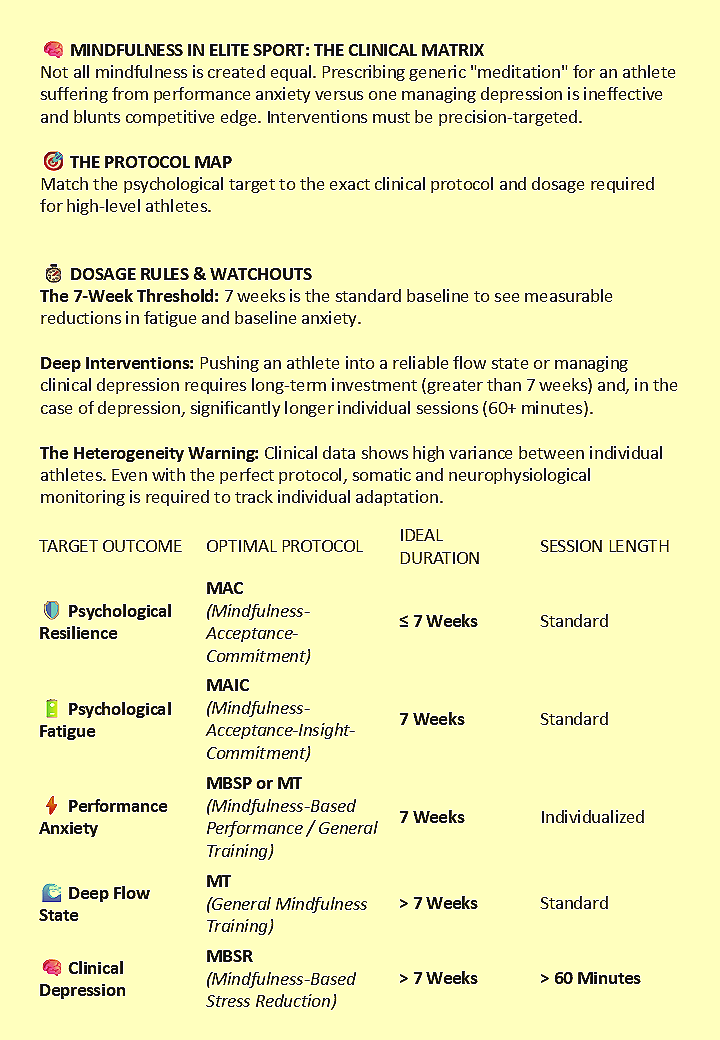
MINDFULNESS IN ELITE SPORT: THE CLINICAL MATRIX
About the Author: Dr. Nadja Snegireva (PhD, MBA) bridges the gap between clinical neurophysiology and the physical realities of human movement. As a Postdoctoral Research Fellow in the Division of Movement Science and Exercise Therapy at Stellenbosch University, her work focuses on the practical application of clinical data to optimize human performance and recovery. Dr. Snegireva utilizes advanced methodologies—including EEG, EMG, and eye-tracking—to identify critical neurophysiological biomarkers. Her current research pioneers interventions for cognitive and motor interference in Parkinson's disease, advances concussion management, and decodes balance deficits in cancer therapy-induced neuropathy. Leveraging her background in international corporate management and her practical expertise as a competitive Latin and Ballroom dancer, she transforms complex clinical research into actionable, real-world movement strategies.
